Architectural music zones
Use in-ceiling or in-wall speakers for kitchens, dining rooms, bedrooms, offices and gathering spaces where sound should be present but equipment should disappear.

Whole-home and architectural audio
Sonos Amp is the practical bridge between clean architectural speakers and the familiar Sonos listening experience. It can drive passive in-ceiling, in-wall, bookshelf or weather-resistant speakers, accept a traditional audio source, connect to a television, and join other Sonos rooms from the same app.
Integrator guidance
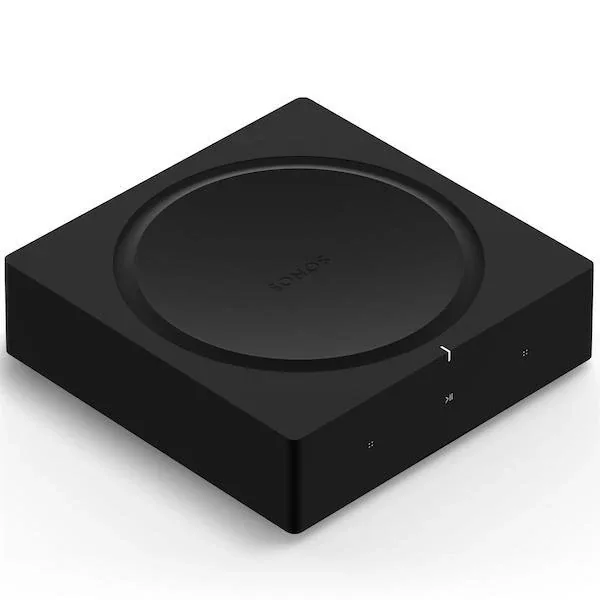
The value of Sonos Amp is not simply that it streams music. Its real value is flexibility. A pair of discreet ceiling speakers in a kitchen, an outdoor speaker system on a terrace, a two-channel television room, or an existing turntable can all become part of a coordinated multiroom system without placing a powered speaker on every surface.
That flexibility also creates design decisions. Speaker impedance, wire length, room coverage, rack temperature, network topology, television audio format, and source gain all affect the finished result. Davis Audio & Video designs those details together so the system sounds balanced and starts the same way every time.
For Chicago homes, condominiums and renovations, Amp is especially useful when visible equipment needs to be minimized. It can live in a local cabinet or centralized rack while the room is left with only speakers and a simple control experience.
Where Sonos Amp is the right fit
Use in-ceiling or in-wall speakers for kitchens, dining rooms, bedrooms, offices and gathering spaces where sound should be present but equipment should disappear.
Power properly selected outdoor speakers for a patio, roof deck, garden or pool area. Coverage and volume should be distributed across the space rather than forced from one loud pair.
Connect a television through HDMI ARC/eARC and use passive front speakers for a more natural stereo presentation. Wireless Sonos surrounds can be added where the room and design support them.
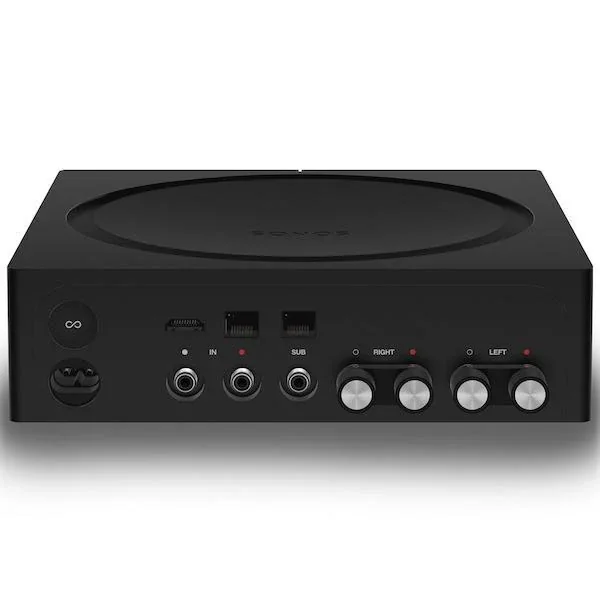
Bring a turntable with the correct phono stage, CD player or other line-level source into Sonos through the RCA input, then make that source available to grouped rooms.
Start with the rooms that matter most and add additional Amp zones later. Each Amp remains its own controllable zone and can be grouped with other Sonos rooms when desired.
What a well-designed Amp system does better
Sonos rates Amp at 125 watts per channel into 8 ohms. With compatible speakers and a correctly calculated load, that is useful output for everyday architectural audio and many outdoor applications. The amplifier can be centralized while the room remains visually quiet.
The Sonos app, AirPlay 2, supported music services and compatible automation integrations provide several ways to listen. We simplify those choices around the client’s habits instead of expecting every family member to learn every available feature.
RCA line-in makes it possible to retain a favored analog source. HDMI ARC connects television audio. Streaming provides the modern layer. A thoughtful input plan keeps source switching and volume behavior predictable.
A Sonos room is a control zone, not merely a pair of speakers. We map zones to real living patterns—such as kitchen, terrace and primary suite—so grouping is useful and independent volume control remains intuitive.
Professional design
The most common Amp problems begin before the product is powered on. Too many speakers may be placed on one channel without a verified impedance plan. Speakers may be positioned for visual symmetry rather than even coverage. Long wire runs may be undersized. A closed cabinet may have no thermal strategy. A television may be connected through a port or audio setting that prevents the expected format from reaching the Amp.
Network design matters as well. Amp supports 2.4 GHz 802.11 b/g/n Wi-Fi and includes two 10/100 Ethernet ports. In an equipment rack, a deliberate wired connection is often preferable; in other rooms, wireless performance depends on access-point coverage and channel planning. We decide that as part of the network—not after dropouts appear.
Finally, the handoff should reflect how the home is actually used. A homeowner may want one app for music, a Control4 remote for television, and a wall keypad scene for entertaining. Those interfaces can coexist when the room and source behavior are programmed intentionally.
How Sonos Amp fits into a Davis Audio & Video system
Amp can power appropriately matched architectural speakers while the speaker family is selected for room size, listening level, finish and coverage.
Supported integration can place commonly used Sonos functions alongside television, lighting, shades and room-off commands. The design should avoid duplicating controls that make operation less clear.
Reliable streaming depends on a stable router, switching and wireless environment. Rack-mounted Amps benefit from labeled Ethernet, power management and ventilation.
HDMI ARC/eARC, CEC behavior, lip sync, source audio settings and the TV remote path are tested together so “watch TV” remains a one-action experience.
Specifications
The specifications below reflect Sonos manufacturer information reviewed July 2026. Speaker compatibility and system performance still depend on the complete load, wiring and room design.
| Amplifier output | 125 watts per channel at 8 ohms |
|---|---|
| Audio output modes | Stereo or dual mono |
| Home-theater formats | Stereo PCM, Dolby Digital, DTS Digital Surround |
| Room correction | Trueplay with supported Sonos Architectural by Sonance speakers and a compatible iOS device |
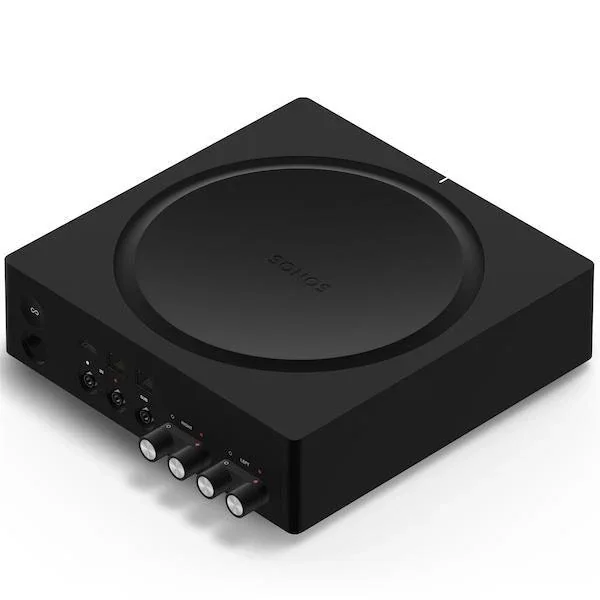
| Speaker connections | Two custom-designed banana-plug outputs; standard-diameter plugs can be substituted |
| Analog input | Stereo RCA line-in |
| Subwoofer output | Auto-detecting RCA; adjustable 50–110 Hz crossover |
| Television input | HDMI ARC; connects to a TV HDMI eARC/ARC port; optional Sonos optical adapter for optical-only TVs |
| Networking | 2.4 GHz 802.11 b/g/n Wi-Fi; dual 10/100 Ethernet |
| Wireless playback | Apple AirPlay 2 |
| Dimensions | 2.52 H × 8.54 W × 8.54 D inches |
| Weight | 4.63 lb |
| Power | 100–240 V, 50/60 Hz internal supply |
| Processor | Quad-core 1.3 GHz A7 |
Planning notes
Davis Audio & Video process
We start with how the room is used, what needs to be simple, which equipment is staying, and where future expansion is likely. For new construction or remodeling, we coordinate before walls close.
We match the product to the room, speaker load, network, display, control platform, wiring path, and aesthetic requirements. The goal is a complete operating system—not a collection of unrelated boxes.
Mounting, wiring, rack placement, ventilation, labeling, surge protection, and network connections are completed with serviceability in mind. Concealed work is documented whenever practical.
We configure the everyday experience, verify signal paths, tune audio or picture settings, test control from the primary interfaces, and check the edge cases that usually create support calls later.
We explain the few controls that matter, leave the system in a predictable state, and provide a support path. Davis Audio & Video’s standard is simple: if the system is difficult to use, the project is not finished.
FAQs
Yes. Sonos Amp is designed to power passive wired speakers, including appropriately matched in-ceiling and in-wall models. The important design work is confirming impedance, power handling, room coverage, wire gauge and how many independent volume zones are required.
Yes. Amp uses HDMI ARC and connects to a television’s HDMI ARC or eARC port. A television with optical output only can use the optional Sonos optical audio adapter. We also test CEC, remote volume, lip sync and source-device audio settings.
No. Sonos lists Stereo PCM, Dolby Digital and DTS Digital Surround for Amp’s home-theater input. For a Dolby Atmos soundbar experience, Sonos Arc Ultra is the more appropriate starting point.
Yes, through the stereo RCA line-in. The turntable must provide line-level output, either through a built-in phono preamp or a separate phono stage. We set source naming and input level so it behaves consistently with streaming sources.
Amp requires a network and internet access for setup, services and updates. It can connect over supported 2.4 GHz Wi-Fi or Ethernet. In a centralized rack, we normally evaluate a wired network connection for stability and serviceability.
One Amp is one Sonos zone. It may feed more than one properly engineered speaker pair within that zone, but all connected speakers share the same source and volume. Independent rooms normally receive independent Amp zones.
Yes. Sonos describes Amp as rack-mountable, and several professional mounting solutions are available. A good rack design also addresses spacing, ventilation, labeled speaker wiring, network connections and surge protection.
No. Sonos specifies Trueplay support for compatible Sonos Architectural by Sonance speakers and a compatible iOS device. Other passive speakers can still be adjusted with bass, treble and loudness controls, but they do not receive that supported Trueplay workflow.
Sonos supports partner integrations including Control4. We design the control path around the room: for example, a Control4 remote can handle the television experience while the Sonos app remains the primary music-discovery interface.
Related Davis Audio & Video resources
Next step
Davis Audio & Video can help match products to wiring, control, acoustics, networking, mounting, calibration and long-term support.