New construction and major renovation
Centralized or hybrid lighting can reduce wall clutter, preserve flexibility, and coordinate fixtures, shades, controls, and electrical panels before drywall.

Keypads, dimmers, switches, and centralized lighting
Control4 lighting controls can make a home simpler at the wall and more responsive behind the scenes. Keypads, dimmers, switches, fan controls, outlets, and centralized modules become a coordinated lighting system in which a clearly labeled button can prepare an entire room instead of asking the homeowner to adjust five separate loads.
Integrator guidance
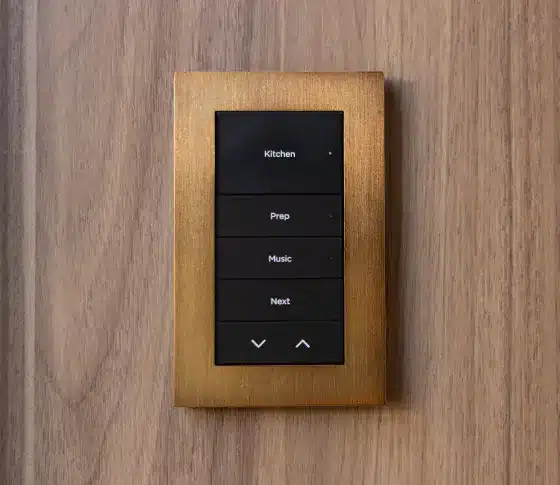
Good lighting control begins with lighting design. Fixtures, beam spreads, color quality, dimming curves, switching zones, daylight, reflected surfaces, and the purpose of each scene should be defined before button labels are chosen. Control4 provides the control layer, but the finished experience depends on the quality of the loads and the decisions made during electrical planning.
Lux and Contemporary controls can provide configurable button layouts, custom engraving, backlighting, status feedback, and coordinated finishes. Adaptive-phase dimmers broaden compatibility across many residential load types. Wireless switches handle appropriate non-dimming loads and motors. Centralized modules move dimming and relay hardware into panels, reducing visible wall controls and making keypad-driven scenes especially powerful in new construction.
Davis Audio & Video programs lighting around natural actions: Welcome, Entertain, Cooking, Dining, Relax, Movie, Pathway, Good Night, and Away. We avoid unlabeled mystery buttons and excessive scene counts. A person entering the room should understand the important controls without a tutorial, while the app and touchscreens remain available for deeper adjustment.
Control4 lighting solutions by project type
Centralized or hybrid lighting can reduce wall clutter, preserve flexibility, and coordinate fixtures, shades, controls, and electrical panels before drywall.
Replace strategic wall devices with compatible wireless dimmers, switches, and keypads where wiring, neutral, box depth, and load conditions permit.
Use coordinated finishes, custom engraving, and carefully edited button layouts so the control belongs in the room rather than reading like technical equipment.
One command can create a safe pathway, close shades, set accent lighting, shut down selected areas, or prepare entertaining spaces.
Appropriate Control4 devices can support boardrooms, hospitality, retail, and other environments, subject to load, voltage, code, and project requirements.
What the lighting-control system can deliver
A single button can set multiple loads to designed levels, coordinate shades and media, and change the room from task lighting to evening ambiance.
Select button counts and engravings that match the room. The button should describe the result—such as Dinner or All Off—not the relay number.
Compatible adaptive-phase products can be configured for forward- or reverse-phase loads as appropriate, improving flexibility across many fixture types.
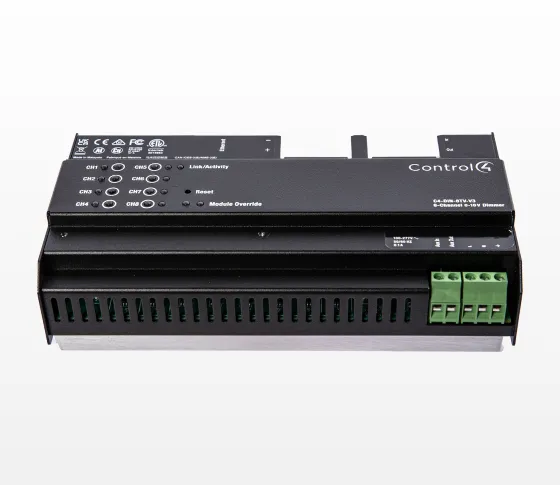
Panelized dimming and relay modules move load control out of the room and allow elegant keypad-only wall locations in suitable projects.
Exterior, pathway, accent, and vacation behaviors can respond to time, sunrise/sunset, security state, or sensors while retaining clear manual override.
Professional design
LED compatibility is determined by the complete fixture, driver, transformer, load size, dimming method, and control—not by the word dimmable on a box.
Circuiting, panel schedules, neutral conductors, three-way locations, load types, fixture wattage, emergency requirements, and keypad power must be documented before rough-in.
Davis Audio & Video workshops the expected room behavior, then names buttons. Engraving too early often creates controls that no longer match the final programming.
Local on/off and dimming must remain predictable. Schedules and occupancy logic should enhance the home without preventing direct control.
We verify low-end trim, high-end trim, fade time, flicker, pop-on, dropout, buzzing, thermal behavior, scene levels, and response after power restoration.
Lighting becomes more useful when systems cooperate
Electric light can respond with natural light, privacy, glare, and heat gain so scenes feel complete.
Movie or Watch scenes can lower selected lights gradually, close shades, and start the intended source from one remote command.
Away, alarm, entry, and pathway events can use deliberate lighting behavior without turning every motion event into a nuisance.
Lighting scenes can work with climate, fans, fireplaces, and Vibrant tunable-white schedules to support the way the home changes through the day.
Specifications
| Lux Keypads | Premium keypad family with configurable layouts, engraving, status illumination, and coordinated finish options |
|---|---|
| Contemporary Keypad Dimmer | Configurable 2–7 button layouts with numerous arrangements; integrated dimming and scene control |
| Contemporary Wired Keypad | Low-voltage keypad for centralized or supported wired architectures, with configurable button layouts |
| Adaptive Phase Dimmer | Supports appropriate forward- or reverse-phase loads, including many LED, incandescent, halogen, ELV, MLV, fluorescent, and CFL applications |
| Wireless Switch | Switching for appropriate lighting, fan, motor, and other non-dimming loads; current voltage/load specification must be verified |
| Variable Fan Speed Controller | Four fan speeds plus off for compatible fan motor loads |
| Centralized Lighting Modules | Model-dependent multi-circuit dimming and relay modules for panelized systems |
| Centralized Panels | Control4 lists 2-slot and 5-slot panel options for supported module configurations |
| Contemporary keypad dimmer | Available in model-dependent 120 V, 240 V, and 277 V applications |
|---|---|
| Contemporary wired keypad | Low-voltage keypad; finish and button configurations vary |
| Adaptive phase dimmer | Model-dependent 120 V, 240 V, and 277 V support |
| Wireless switch | Model-dependent 120/277 V or 240 V versions |
| Centralized modules | Control4 lists modules for 120 V, 240 V, and 277 V environments, depending on product |
| Finishes | Lux and Contemporary finish availability varies; metallic exclusions and regional catalogs must be checked |
Davis Audio & Video process
Davis Audio & Video starts with the room, the household, and the result the client expects—not with a product list. We document existing equipment, construction conditions, wiring access, network health, aesthetic priorities, security requirements, and the controls people already understand.
We select the correct Control4 or Lutron architecture, verify electrical and low-voltage requirements, coordinate with architects, designers, builders, electricians, HVAC professionals, and window-treatment workrooms, and produce a system plan that can be installed and serviced without guesswork.
Devices are mounted, wired, labeled, updated, and programmed as one operating system. Scenes, schedules, room-off behavior, notifications, user permissions, and remote interfaces are tested from the controls the family will actually use.
We verify normal operation, failure recovery, network communication, audio or video performance, and safety-related behavior. The homeowner receives a clear walkthrough focused on everyday actions. Davis Audio & Video considers the project unfinished if the system is powerful but difficult to operate.
The final configuration is documented so future service, additions, or renovations can be completed efficiently. Davis Audio & Video can support software updates, programming changes, seasonal adjustments, and expansion as the home evolves.
FAQs
A dimmer directly controls a compatible lighting load. A keypad sends programmed commands and may not control a local load. Some Control4 products combine keypad and dimmer functions. The correct device depends on wiring and system architecture.
Yes, with compatible fixtures, drivers, transformers, minimum loads, and dimming methods. Davis Audio & Video verifies the complete load and commissions low- and high-end performance because LED products vary significantly.
Lighting circuits return to dimming or relay modules in a panel, while low-voltage keypads provide room control. It is most practical in new construction or major renovation and can reduce visible wall controls.
Yes. Many projects use a hybrid approach: centralized lighting in key spaces, smart wall-box controls elsewhere, and conventional control where automation adds little value.
Yes. Button labels and layouts can be customized within the selected Control4 family. Davis Audio & Video finalizes scene behavior before approving engraving.
Yes. A scene can affect multiple loads and subsystems. Davis Audio & Video distinguishes room-specific commands from whole-home commands and uses press-and-hold or confirmation carefully to prevent accidental global changes.
Local lighting control and Control4 automation are designed to operate on the local system. Cloud services, remote access, and voice may be unavailable, but essential wall control should remain usable.
Control4 lists selected products and centralized modules for 277 V applications. Exact product, load, code, enclosure, and electrician requirements must be verified for the project.
Control4 can integrate compatible color-capable lighting, including Vibrant Linear Lighting and supported third-party systems. The driver, control protocol, fixture, and user interface determine available color and temperature functions.
Usually fewer than a homeowner initially imagines. Davis Audio & Video prioritizes a small set of distinct, useful outcomes and leaves granular adjustment in the app or touchscreen. Simplicity is part of the lighting design.
Related Davis Audio & Video resources
Next step
Davis Audio & Video can help match products to wiring, control, acoustics, networking, mounting, calibration and long-term support.