Remote equipment racks
Keep streaming boxes, disc players, video processors and control hardware in a ventilated serviceable rack while sending video to a cleanly mounted display.

Long-distance 4K video distribution
AVPro Edge HDMI extenders solve a problem that appears in nearly every serious custom video system: the display and the source equipment are not in the same place. A matched transmitter-and-receiver kit can carry high-bandwidth video across a properly specified category cable while also supporting control, audio return and system-management features that a passive long HDMI cable cannot provide as predictably.
Integrator guidance
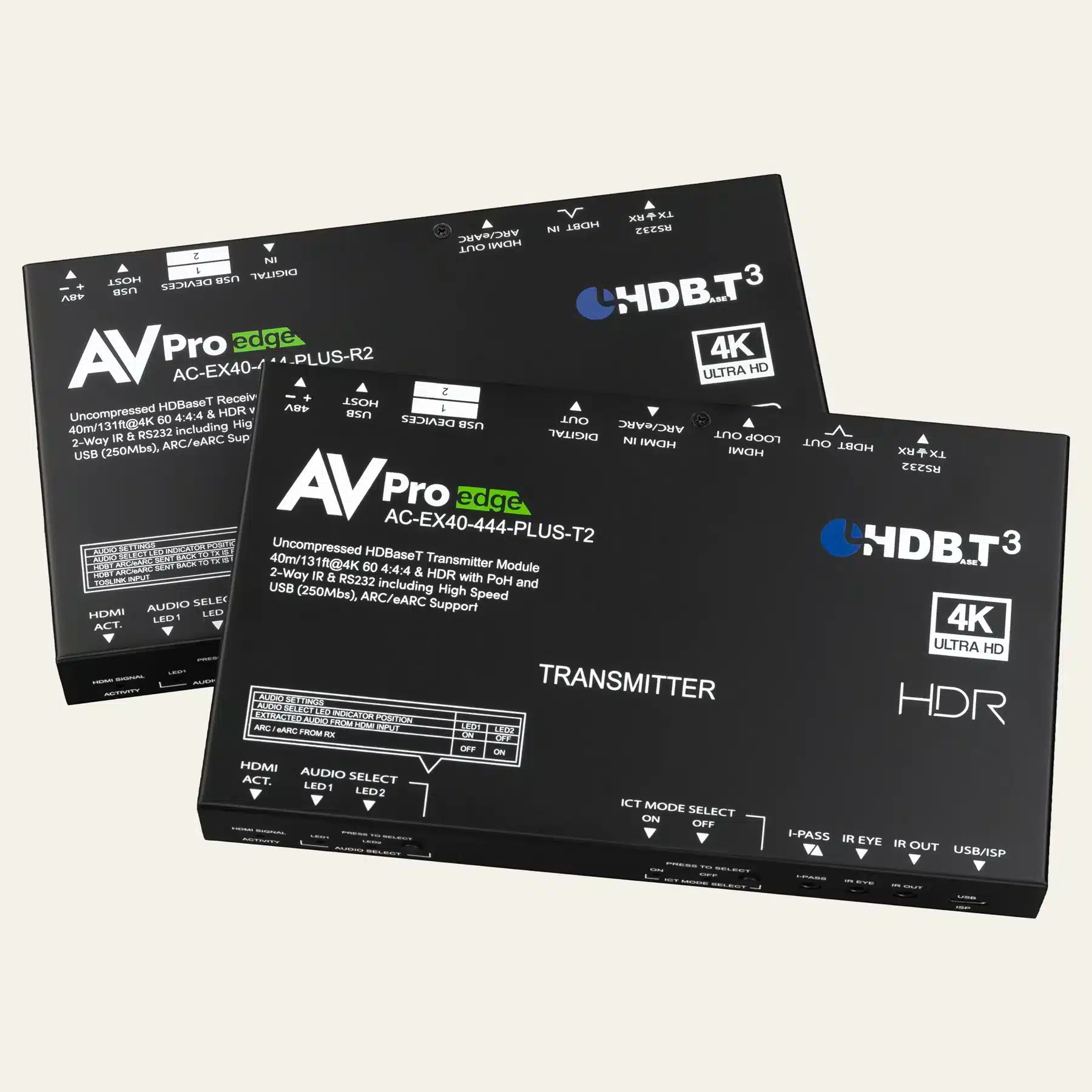
In a custom home, the source may live in an equipment rack while the television is across the room, on another floor or outdoors. The cable route may include conduit, wall plates, patch points and tight bends. At 18 Gbps, every part of that path matters. Extender performance is therefore a system result—not a promise created by the category printed on the cable jacket.
Davis Audio & Video selects the extender around resolution, chroma, bit depth, HDR, distance, audio-return requirements, control method and future serviceability. We then test the complete source-to-display chain using the actual source devices and programmed activities. That is how a video system becomes dependable enough for one-button use.
The AC-EX40-444-PLUS-KIT is a useful reference because it combines uncompressed 18 Gbps transport at shorter distances with a selectable ICT mode for longer 10.2 Gbps paths. AVPro Edge also offers longer-reach and application-specific models, so the final kit should be selected from a documented signal plan rather than by distance alone.
Where an AVPro Edge extender belongs
Keep streaming boxes, disc players, video processors and control hardware in a ventilated serviceable rack while sending video to a cleanly mounted display.
Reach a ceiling-mounted or rear-of-room projector through a category-cable pathway that is easier to route and replace than a long terminated HDMI cable.
Pair the endpoint with a video matrix or centralized source platform so multiple rooms can access shared sources with consistent EDID and control behavior.
Selected AVPro Edge models can transport enhanced audio return so display apps can send audio back toward a remote processor or audio system. Every device in the chain must support the intended format.
Where a suitable category cable already exists, a validated extender may create a high-performance path without opening finished walls. Existing cable still needs inspection and certification.
What the right extender adds to the system
The EX40-444-PLUS is designed for uncompressed 18 Gbps HDMI 2.0 transport up to 40 meters on an appropriate Cat6A link. That supports demanding 4K60 4:4:4 signals when the entire chain is compatible.
Its selectable ICT mode reduces the transport bandwidth to extend certain 4K signals farther—up to a manufacturer-rated 70 meters. This is a design tradeoff, not a universal performance upgrade, and should be chosen against the source and display requirements.
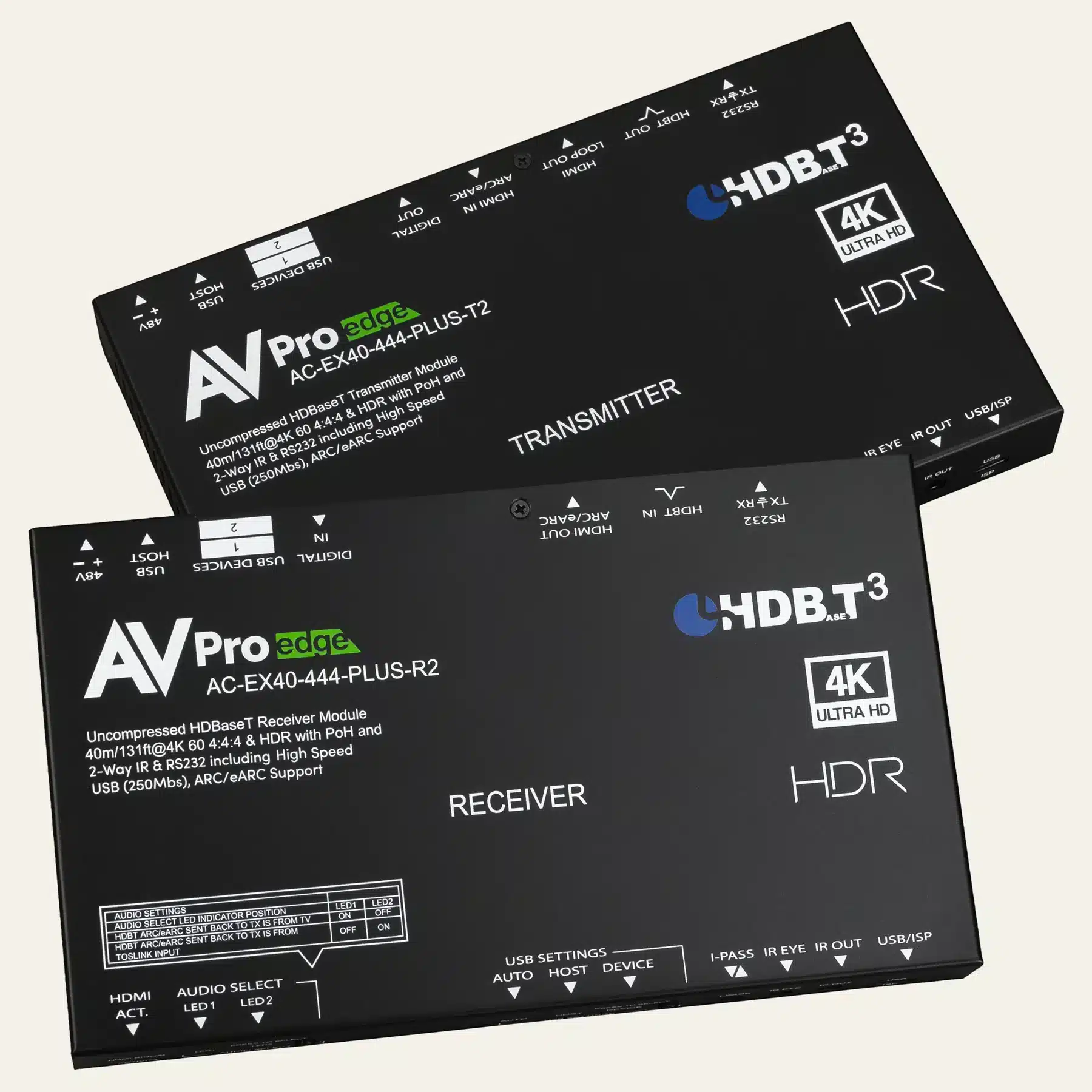
Bidirectional infrared and RS-232, audio extraction, eARC support, test patterns and EDID-management functions reduce the number of separate boxes needed at the display and give the installer better diagnostic control.
Category cabling can be tested, labeled and documented. A failed endpoint can be replaced without repulling the entire route, and the rack remains the central point for source, control and power management.
Professional design
Distance is only one variable. Cable construction, shielding, bend radius, connector termination, keystone modules, couplers, electrical noise and grounding all affect the link. AVPro Edge specifies Cat6A for the EX40 kit's 18 Gbps distance and notes the importance of a clean, properly terminated run. We prefer a continuous, labeled home run and test it before finish work makes correction expensive.
EDID and HDCP are equally important. The source chooses its output by reading capabilities reported through the chain. A matrix, extender, AVR, soundbar or display can change that conversation. We establish a supported common format and document any scaler or down-conversion behavior rather than masking an incompatibility with random reboots.
Finally, advertised reach is conditional. The EX40's full 18 Gbps figure and longer ICT figure assume the specified cable and a compliant system. The AC-EX100-444-KIT is intended for longer runs and carries its own feature set. The correct model is the one that passes the planned signal through the installed path with margin.
How AVPro Edge fits into a video system designed by Davis Audio & Video
The matrix handles source routing while the extender carries the selected output to the room. EDID, scaling and control are coordinated across both layers.
The receiver can terminate behind or near the display. We plan power, ventilation, service access, HDMI-port selection and remote audio-return requirements before mounting the television.
Infrared, serial or IP control can be routed through the programmed activity so the client sees a source name and a single remote—not the transport hardware.
The category cable, patching policy, conduit, labeling and certification become part of the AV drawings. Spare pathways are strongly recommended for displays that may remain in service through several format generations.
Specifications
Representative manufacturer specifications reviewed July 2026. Published distances are conditional on cable, termination, source, display, format, EDID and HDCP behavior. Final engineering must use the exact selected model and installed link.
| Transport platform | HDBaseT 3.0-based transmitter / receiver kit |
|---|---|
| HDMI generation | HDMI 2.0-class, up to 18 Gbps |
| Full-bandwidth distance | Up to 40 m / 131 ft over properly terminated Cat6A; shielded cable preferred |
| Long-reach mode | Selectable 10.2 Gbps ICT mode, manufacturer-rated up to 70 m / 230 ft |
| Maximum video | Up to 4K60 4:4:4, subject to the selected transport mode and complete signal chain |
| HDR support | HDR10, HDR10+, Dolby Vision at supported frame rates, and HLG |
| Latency | Manufacturer states less than 8 microseconds |
| Scaling | 4K / HDR to 1080p downscaling capability |
| Audio | TOSLINK extraction and eARC transport features |
| Control | Bidirectional IR and RS-232 |
| Installer tools | EDID management and built-in test-pattern functions |
| Model | AC-EX100-444-KIT |
|---|---|
| Published reach | Up to 100 m / 328 ft for supported high-bandwidth UHD signals |
| Selection note | Use the exact product data sheet to confirm video, eARC, USB, control and cable requirements for the project revision |
| Design rule | Do not substitute a longer-distance model solely by headline distance; verify the required signal and endpoint features |
Planning notes
Davis Audio & Video process
We start with how the room is used, what needs to be simple, which equipment is staying, and where future expansion is likely. For new construction or remodeling, we coordinate before walls close.
We match the product to the room, speaker load, network, display, control platform, wiring path, and aesthetic requirements. The goal is a complete operating system—not a collection of unrelated boxes.
Mounting, wiring, rack placement, ventilation, labeling, surge protection, and network connections are completed with serviceability in mind. Concealed work is documented whenever practical.
We configure the everyday experience, verify signal paths, tune audio or picture settings, test control from the primary interfaces, and check the edge cases that usually create support calls later.
We explain the few controls that matter, leave the system in a predictable state, and provide a support path. Davis Audio & Video’s standard is simple: if the system is difficult to use, the project is not finished.
FAQs
An HDMI extender moves a source signal farther than a conventional short HDMI connection by using a transmitter, a receiver and another transport medium—commonly category cable or fiber. Selected models can also carry control, audio return and USB functions.
Yes, selected models are designed for high-bandwidth 4K and HDR. The AC-EX40-444-PLUS-KIT supports up to 4K60 4:4:4 in its full-bandwidth mode and common HDR formats, but actual delivery depends on every device and cable in the chain.
AVPro Edge rates uncompressed 18 Gbps transport up to 40 meters or 131 feet on a properly terminated Cat6A link. A selectable ICT mode can carry supported 10.2 Gbps signals up to 70 meters or 230 feet. These are conditional design limits, not guarantees for any existing cable.
No. Cat6A has different performance and construction requirements, and the manufacturer’s published full-bandwidth distance for this kit is based on Cat6A. A short, excellent Cat6 run may work in some systems, but it should not be assumed to meet the Cat6A design claim.
The EX40-444-PLUS includes eARC-related transport features. The television, receiving audio device, HDMI ports, cables and settings all have to support the desired return-audio format, so eARC is commissioned as an end-to-end path.
Higher resolution, frame rate, chroma and bit depth increase bandwidth. A marginal cable, termination, coupler, source setting or display handshake may pass a lower-rate signal and fail at 18 Gbps. Testing the exact output format usually identifies the real limit.
EDID is the capability information a display or downstream device reports to the source. HDCP is copy protection used by commercial content. Extenders, matrices and processors must pass or manage both correctly or the system may select the wrong format, lose audio or show no picture.
A basic extender kit connects one source path to one display endpoint. Multiple displays usually require a matrix, splitter or distribution platform designed for the number of outputs, EDID policy and control method.
Often, yes, provided there is adequate space, power, cable bend clearance, ventilation and future service access. The mounting plan should prevent the television or bracket from crushing connectors and should keep active electronics reachable.
Fiber is valuable for long runs, electrical isolation and future bandwidth, while category cable can support power, control and familiar HDBaseT workflows. Many projects benefit from conduit plus more than one medium. The choice depends on distance, required features and upgrade strategy.
Related Davis Audio & Video resources
Next step
Davis Audio & Video can help match products to wiring, control, acoustics, networking, mounting, calibration and long-term support.