Whole-home vinyl listening
Connect a turntable with a moving-magnet cartridge to the dedicated phono input, or use the line input with a compatible external phono stage. The record can then play through selected BluOS rooms.

Network distribution for turntables, discs and TV audio
Bluesound HUB solves a specific whole-home audio problem: the source and the speakers do not have to be in the same room. It converts supported analog and digital inputs into network sources that compatible Bluesound and BluOS players can select from the BluOS Controller app.
Integrator guidance
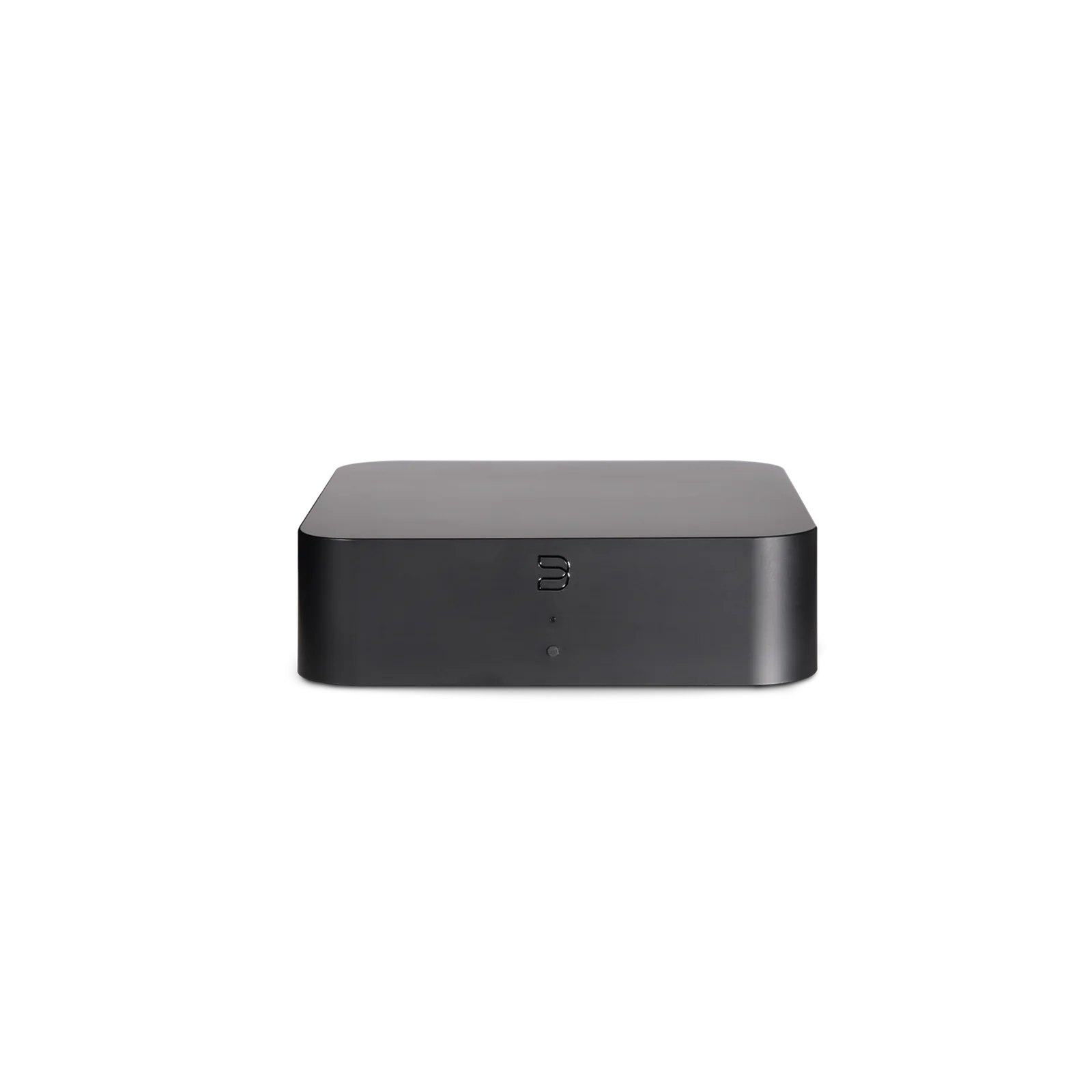
A turntable may belong in the living room while its owner listens in the kitchen. A CD player may stay in the cabinet while music plays in an office. HUB moves those wired source signals across the home network to compatible BluOS rooms.
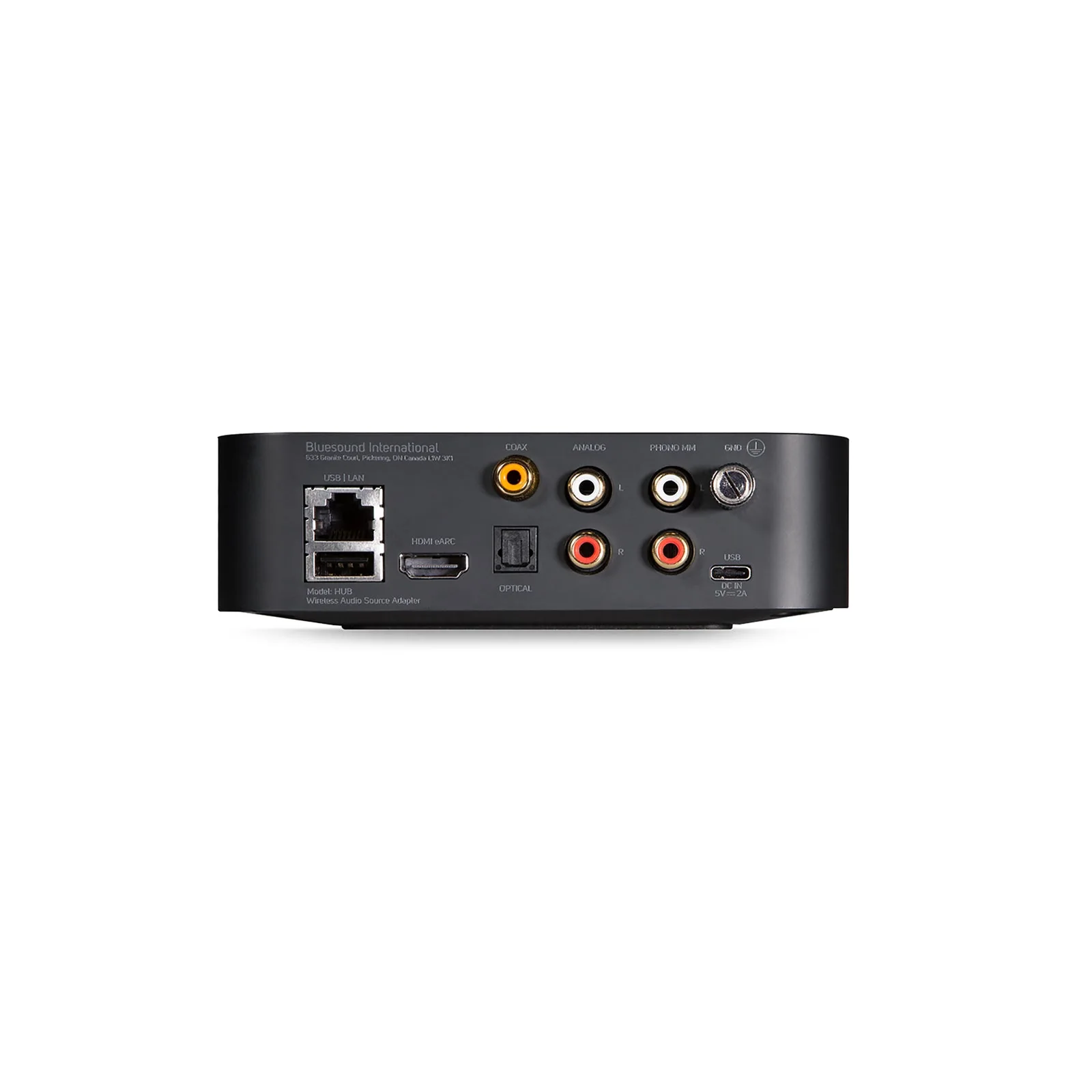
HUB provides HDMI eARC, coaxial and optical digital inputs, plus stereo line-level and moving-magnet phono analog inputs. BluOS exposes them to compatible network players. HUB does not power speakers or provide local audio output; its output is the network.
Davis Audio & Video specifies HUB when source location and BluOS playback needs align. We verify cartridge type, source level, TV return audio, network, player compatibility and control before installation.
Where Bluesound HUB is the right fit
Connect a turntable with a moving-magnet cartridge to the dedicated phono input, or use the line input with a compatible external phono stage. The record can then play through selected BluOS rooms.
A CD player, tuner, tape deck or other compatible component can use line, coaxial or optical input. The source remains physically accessible while its audio becomes available elsewhere on the network.
A compatible TV can return audio through HDMI eARC to HUB for playback on supported BluOS players. Television format, delay, CEC and player configuration must be tested in the actual room.
HUB can live near the source rather than near every speaker. This is useful in finished Chicago homes and condominiums where new analog cable paths would be disruptive but a stable network is available.
What a well-designed HUB system does better
Vinyl, CDs and other wired sources can participate in the same multi-room environment as streaming services. The source keeps its familiar physical experience while BluOS handles room selection and grouping.
HDMI eARC, coaxial, optical, stereo line and moving-magnet phono inputs cover common home audio sources without requiring a separate analog-to-network accessory for each connection type.
Bluesound permits one analog input and one digital input to stream simultaneously to different BluOS players. It does not permit two analog or two digital HUB inputs to play at the same time.
Bluesound specifies up to four HUB units on one network, providing as many as eight simultaneous streams when each HUB is using one analog and one digital source. The network and user interface must be planned for that scale.
Professional design
HUB is a source bridge, not a local-output player or speaker amplifier. Every room needs a compatible BluOS endpoint such as a Bluesound speaker, POWERNODE or NODE-connected system. Davis Audio & Video maps that architecture before equipment is ordered.
Only one digital and one analog input can stream simultaneously from each HUB. Its phono stage is for moving-magnet cartridges; a moving-coil or incompatible cartridge needs the correct external stage at line level. Gain, grounding and turntable placement still matter.
HDMI eARC returns audio from a compatible TV; it is not a general input for a streaming box or disc player. Sources normally connect to the TV. We test format, CEC, source selection, lip sync, network stability and control.
How HUB fits into a Davis Audio & Video system
A NODE-connected main system can select a HUB source alongside streaming services and network libraries, preserving an existing amplifier and speakers within the BluOS environment.
Amplified and wireless BluOS rooms can select the turntable, CD player or other HUB input. Rooms may listen independently or group when synchronized playback is desired.
Bluesound lists Control4, Crestron, URC, RTI, ELAN and Lutron integration for HUB via software support. Davis Audio & Video confirms current driver behavior and keeps source naming consistent across interfaces.
HUB offers Gigabit Ethernet and dual-band Wi-Fi 5. Fixed source locations often favor wired Ethernet, while all playback rooms still require stable network connectivity.
Specifications
The following details reflect official Bluesound product and support information reviewed July 29, 2026. Davis Audio & Video confirms the current version, firmware, player compatibility, control driver and availability before installation.
| Version | CB130 |
|---|---|
| Analog inputs | One stereo RCA line input and one stereo RCA moving-magnet phono input |
| Digital inputs | HDMI eARC with CEC, TOSLINK optical and 75-ohm RCA coaxial |
| Audio output | Network only to compatible BluOS players |
| Simultaneous streams | Two per HUB: one analog input and one digital input |
| Maximum HUB units | Four per network, for up to eight simultaneous streams |
| Native resolution | Up to 192 kHz, 16- to 24-bit |
| Frequency response | 20 Hz to 20 kHz, plus or minus 0.3 dB; 50 kHz at -3 dB |
| Operating system | BluOS |
|---|---|
| Network | Gigabit Ethernet and dual-band Wi-Fi 5 |
| Controller platforms | BluOS Controller for iOS, Android, Windows and macOS |
| Power | External universal USB-C power adapter |
| Dimensions | 143 x 153 x 45 mm |
| Weight | 0.63 kg |
| Finish | Black matte satin |
| Published control integrations | Control4, Crestron, URC, RTI, ELAN and Lutron via software support |
Planning notes
Davis Audio & Video process
Davis Audio & Video reviews the physical sources, cartridge or output type, desired listening rooms, existing BluOS products, network and control expectations.
We map each source to HUB inputs, account for simultaneous-stream limits and confirm the compatible player and amplification required in every destination.
HUB is placed near its sources with stable power, short labeled interconnects, Ethernet when practical and appropriate turntable grounding and isolation.
We update firmware, name inputs, test analog and digital streams, verify grouping, check TV audio and lip sync, and confirm supported control behavior.
Davis Audio & Video demonstrates how to start the physical source, select it in each room, group players and return to normal streaming.
FAQs
HUB converts supported wired sources into network sources for compatible BluOS players. A turntable, CD player, analog component or TV can remain near HUB while selected rooms play it.
No. HUB outputs audio to the network. Each room needs a compatible endpoint and any required amplification. POWERNODE adds amplification; NODE connects BluOS to an existing system.
Yes, with a compatible moving-magnet cartridge. A moving-coil or incompatible output needs the correct external phono stage connected to HUB's stereo line input.
One analog and one digital input can stream simultaneously. Two analog or two digital sources cannot play at once from the same HUB, though several may remain connected.
Bluesound specifies up to four HUB units per network. With one analog and one digital stream from each, the published maximum is eight concurrent streams.
HUB accepts TV return audio through HDMI eARC with CEC. Sources normally connect to the TV. Davis Audio & Video verifies format, delay, lip sync and playback configuration.
Bluesound lists Control4 and other professional integrations. Davis Audio & Video verifies the current driver and commands before adding HUB sources to the control experience.
HUB supports dual-band Wi-Fi 5 and Gigabit Ethernet. At a fixed location, Davis Audio & Video evaluates wired Ethernet first for stability and serviceability.
Related Davis Audio & Video resources
Next step
Davis Audio & Video can help match products to wiring, control, acoustics, networking, mounting, calibration and long-term support.